Short answer: a parking barrier supports access control at an industrial site by acting as a physical checkpoint that only opens when a vehicle, a driver or a booking has been authorised. It does this by working with an access controller that receives input from RFID tags, ANPR cameras, intercoms, keypads or a booking system, and then decides whether the lane should open. The barrier itself does not verify anybody: it enforces a decision made elsewhere. That is why the specification has to cover the barrier, the reader, the controller and the safety devices together, not the barrier alone.
At a factory, distribution centre, warehouse, logistics park or utility compound, the site entrance is the one place where every vehicle can be checked. A barrier placed there turns an open driveway into a controlled lane. When it is connected to an access-control system, it can work from an authorised vehicle list, staff credentials, contractor permits, visitor approvals, delivery bookings or number plate recognition, so that vehicle movements become structured and traceable rather than a matter of who arrived first.
The useful question is not whether a barrier can be fitted. It is which combination of barrier, reader and controller suits the traffic the site actually receives, and what happens on the day the reader fails, the network drops or an HGV arrives with a trailer that hides its plate. This guide works through that in the order a UK industrial project usually meets it.
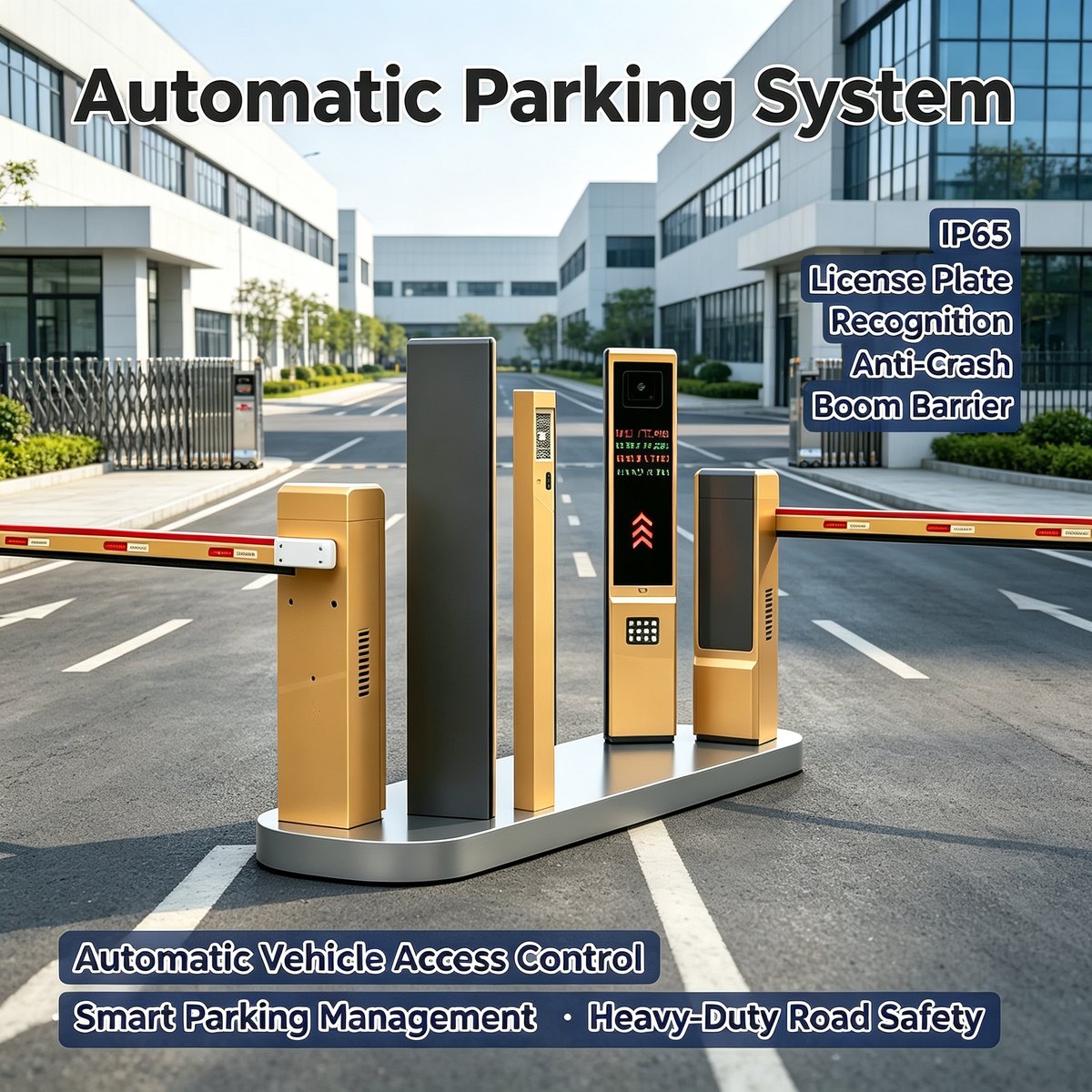
Industrial sites rarely see one kind of traffic. A single shift change can bring employee cars, contractor vans, HGVs, delivery lorries, maintenance engineers and visitors through the same gate within twenty minutes. Without a defined entry process, unauthorised vehicles can reach loading bays, production yards or restricted storage areas, and the gatehouse has no reliable record of who came in or when.
Uncontrolled arrivals also cost money in less obvious ways. Queues back onto the public road, delivery slots slip, drivers improvise turning manoeuvres in yards designed for much smaller vehicles, and an incident investigation becomes a matter of recollection rather than record.
A parking barrier is not a complete security system on its own. It provides a physical means of controlling a lane. Credentials, visitor procedures, CCTV, intercoms, alarms and site rules determine who should be allowed through. The most effective installations treat the barrier as one component of a wider vehicle and pedestrian access plan, which is why the sections below follow the access decisions rather than the hardware.
The simplest application is to stop casual or unauthorised vehicles driving straight into the yard. The boom stays down until a recognised credential or an approved command is received. Depending on site policy, that authorisation may come from an RFID tag, an access card, a keypad code, a remote control, an approved visitor entry or an ANPR match against an authorised vehicle list.
For a factory with regular staff parking, RFID credentials give quick repeat access with very little driver interaction. For a site receiving frequent deliveries, ANPR can identify registered fleet vehicles without asking the driver to present a card at the window. Many sites combine both, so that a second credential or a manual approval exists for the day a plate cannot be read or a visitor has not been pre-registered.
Whatever method is chosen, the rule should be written down before the equipment is ordered. Who approves a new vehicle, how quickly a leaver is removed from the list, and who can override the system at three in the morning are policy questions. The equipment can only enforce an answer that somebody has already defined.
A well-planned industrial entrance routes different users through separate lanes or separate procedures. Employees may hold a permanent credential, contractors may need a time-limited permit, and delivery vehicles may be checked against a booking or purchase-order reference before the lane opens. The barrier controller or connected access platform applies those rules before releasing the boom.
This matters most where the gatehouse is busy or the turning area is tight. Clear lane markings, advance signage, a safe waiting position and a documented exception process keep queues from backing onto the public highway. The barrier should be positioned so that an HGV can stop for authorisation without blocking a junction, a pedestrian route or the emergency access route.
Signage deserves more attention than it usually gets. A driver who does not know which lane to use will choose the wrong one, and every wrong choice costs the site a manual intervention at the busiest moment of the day.
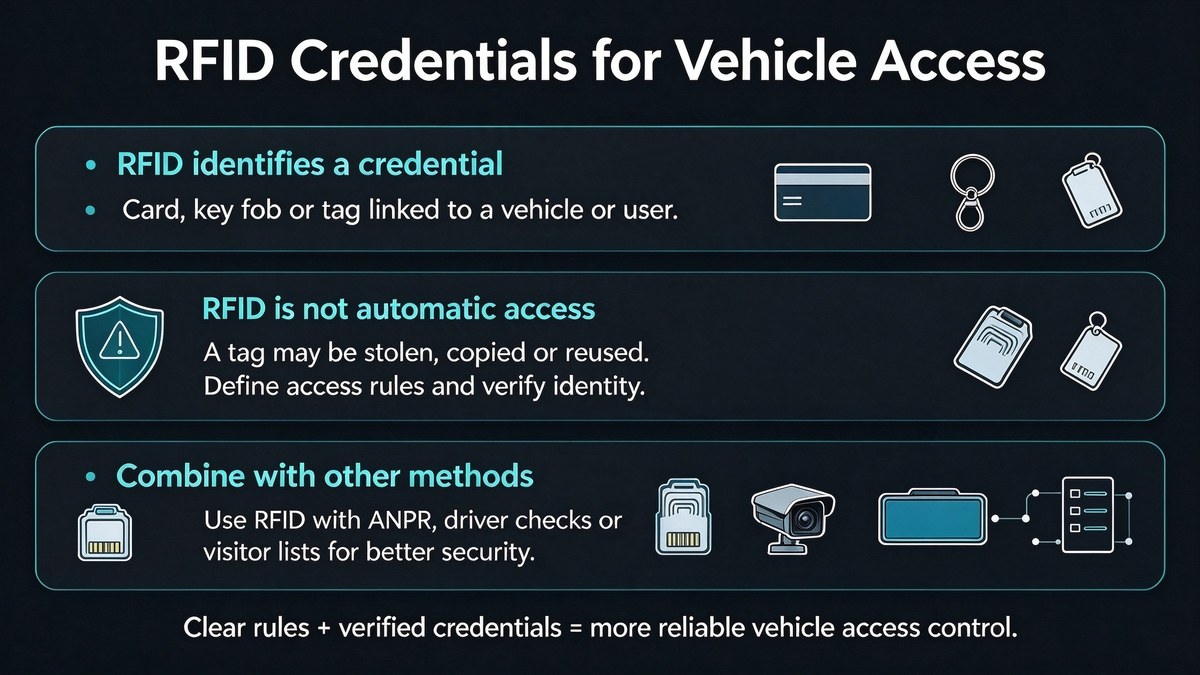
Automatic Number Plate Recognition uses a camera and recognition software to read a vehicle registration mark. The system checks the result against configured permissions and, if the vehicle is authorised and the operating conditions are met, sends an opening command to the barrier controller. In industrial settings ANPR is most useful for regular fleet vehicles, staff cars, approved contractors and pre-booked deliveries.
Recognition performance depends on camera position, lighting, lane width, vehicle speed and the condition of the plates themselves. Industrial sites add their own difficulties: mud, rain, low sun, glare from headlights, unusual vehicle heights, roof bars and trailers that obscure the rear plate of the vehicle in front. A demonstration at the actual lane, at the actual time of day, is worth more than a headline accuracy figure measured in a laboratory.
Ask the supplier to show the proposed camera arrangement and to explain what the system does with an unreadable plate, a mismatch against the list, or a network outage. A failed read should trigger a defined fallback — an intercom call to the gatehouse, a temporary code, a manual release — rather than an improvised decision at the barrier. Our ANPR number plate recognition systems pages set out the camera and controller options; the integration detail still has to be confirmed for the exact pairing.
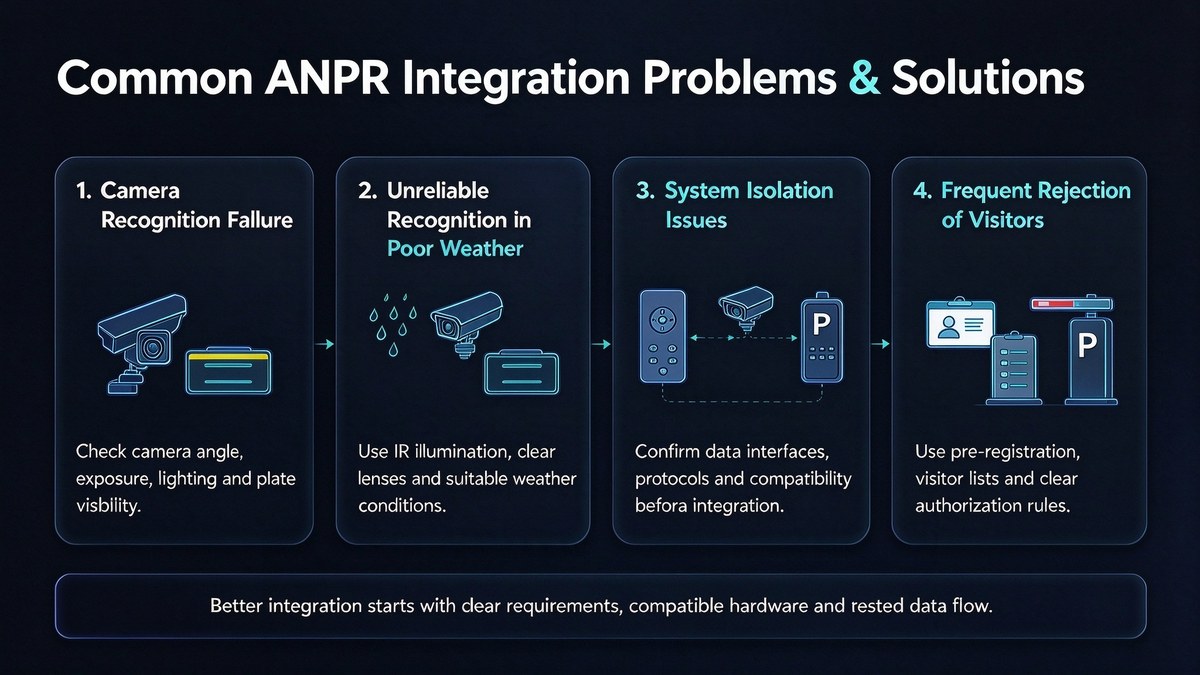
An RFID reader identifies a compatible tag or credential assigned to a vehicle or a user. For regular staff, approved fleet operators or repeat contractors this makes entry quick and consistent, and it works in weather that would defeat a camera. Long-range RFID can identify a vehicle before it reaches the barrier, but the effective reading distance and the installation geometry must be confirmed for the selected equipment and the actual lane.
RFID should not be treated as proof that the vehicle itself is permitted. A lost tag, a shared credential or a vehicle swap creates a gap that no reader can close. Define how tags are issued, suspended and recovered, and consider combining RFID with a vehicle list, a driver check or ANPR where the risk assessment justifies it. Our RFID barrier systems range covers the reader and barrier combinations that suit this pattern.
Distribution centres and manufacturing plants see sharp peaks at shift changes, collection windows and scheduled delivery periods. A barrier chosen for the real traffic volume regulates arrivals and keeps unauthorised vehicles out of the yard. High-speed or high-cycle models suit busy lanes, but the selection has to rest on the manufacturer’s confirmed duty rating, boom length, wind exposure and required opening time — not on the fastest figure in a brochure.
At HGV entrances, check the swept path, the stopping distance, the queue capacity and the space a vehicle needs to clear the barrier before it closes. A barrier that is too slow becomes a bottleneck. A barrier that is too fast, or badly coordinated with the detection equipment, becomes a safety risk. A site survey and a trial operating sequence are the usual way to balance throughput against safe movement.
Cycle count is often underestimated. A lane rated for a few hundred movements a day will not survive a depot running a thousand, and the failure usually appears as overheating in summer rather than as an obvious mechanical fault. Our high-speed barrier gates are intended for these higher-cycle lanes.
The barrier at the main gate is the first checkpoint. Additional barriers or powered gates can then control fuel storage, loading bays, staff parking, chemical stores or other restricted areas, with different permissions and different operating hours for each zone. Layering the site this way means a visitor admitted to reception cannot accidentally drive to the tank farm.
For higher-security locations the vehicle barriers should be designed alongside fencing, lighting, CCTV, guarding procedures and an emergency response plan. A standard parking boom barrier is primarily a traffic-control device. It should not be assumed to stop a determined hostile vehicle, and it does not replace a certified crash-rated barrier. Where impact resistance or hostile-vehicle mitigation is required, specify a system tested and rated for the relevant threat and obtain written confirmation from the supplier.
Zone design also affects how the site behaves on a normal day. A delivery driver who has to be escorted through three barriers will find a way around them; a zone that is genuinely needed and clearly signed will be respected. Our industrial security boom gate is the heavier pattern used where yard traffic is rough and impacts are likely.
Industrial entrances put moving vehicles, pedestrians, cyclists and reversing HGVs within a few metres of each other. The barrier belongs inside a safe traffic layout, with clear signs, good visibility, controlled approach speeds and a defined pedestrian route that does not cross the boom arc.
Vehicle-detection loops, radar, photoelectric beams and other compatible safety devices help detect a vehicle under the boom and prevent it closing at the wrong moment. On a busy site, a vehicle detection radar is often the more practical choice for a lane where digging a loop is difficult or where the surface is shared with HGVs.
Safety devices must be selected, installed and tested for the actual barrier model and the site risk assessment. They do not remove the need for safe lane geometry, maintenance, driver and pedestrian training, or a documented emergency-release procedure. Confirm the applicable UK legal requirements and relevant standards with a competent installer or safety professional before commissioning.
When the barrier is connected to a suitable access-control or parking-management platform, the system can log the time of a request, the credential or registration presented, the access decision and the barrier event. Those records help a site team settle a delivery dispute, review unusual access attempts and understand how traffic actually moves through the yard.
Industrial operators should decide who can view or export the logs, how long records are kept and how the data is protected. Where number plates are recorded, the applicable UK data-protection obligations apply: appropriate notices, a documented purpose and a defined retention period. Advice should come from the organisation’s data-protection lead; this article is not legal advice.
Most industrial requirements resolve into one of five patterns. The table is a starting point for a specification conversation, not a substitute for a site survey.
| Site requirement | Possible configuration | Key checks |
|---|---|---|
| Regular employee vehicles | Boom barrier plus RFID reader | Credential administration, reading distance, peak traffic |
| Approved fleet and visitor vehicles | Boom barrier plus ANPR plus access software | Plate-read conditions, list updates, fallback process |
| Busy warehouse or distribution centre | Duty-rated boom barrier plus vehicle detection plus access controller | HGV geometry, cycle rating, queue length, safety devices |
| Restricted internal zone | Barrier or powered gate plus role-based permissions | Zone policy, CCTV, fencing and emergency access |
| Mixed staff and delivery traffic | Separate lanes or operating rules plus ANPR, RFID or manual approval | Signage, lane allocation, exception handling |
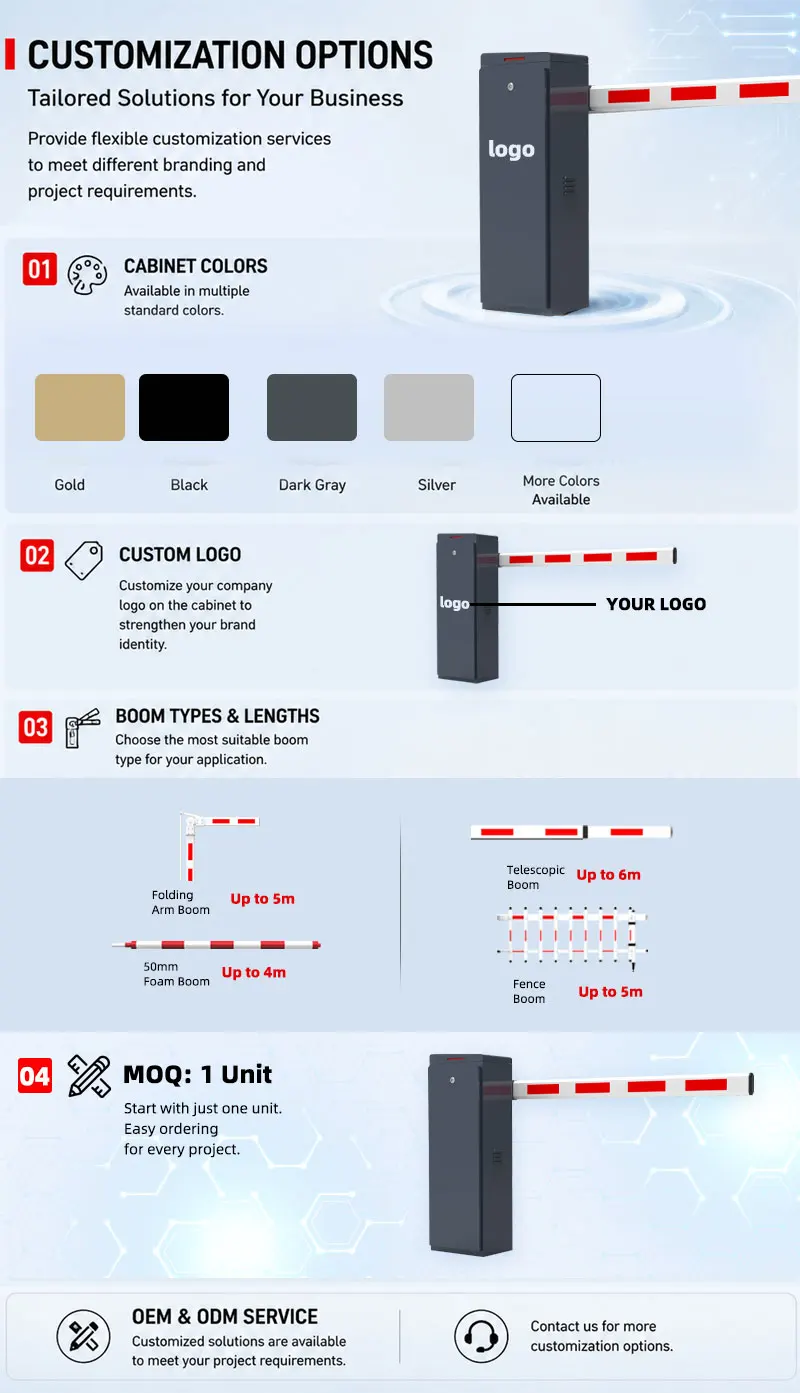
Before ordering, confirm the boom length, duty cycle, motor type, power supply, environmental protection, control interfaces, safety accessories, warranty, spare-parts support and installation requirements for the exact model. Our automatic boom barrier systems pages list the available categories, and compatibility with your chosen reader should be confirmed in writing for the proposed combination.
An industrial access-control system should be maintained to the manufacturer’s instructions and to the conditions it actually works in. Routine checks typically cover the boom arm and fixings, the cabinet and its foundation, limit settings, safety devices, reader alignment, camera image quality, network connectivity, controller logs and the emergency-release arrangement.
Permissions need reviewing as regularly as the hardware. Remove leavers’ credentials, update contractor and vehicle lists, expire temporary permits and look at unusual access events. For sites that run continuously, agree spare parts, remote technical support and a response arrangement with the supplier before a fault stops the gate at two in the morning.
Baroxon supplies automatic boom barriers, high-speed barrier gates, ANPR and LPR systems, RFID options, radar sensors and pedestrian turnstiles for UK projects. Product information covers interfaces such as relay, RS485, Wiegand and TCP/IP, which helps a project team plan around access-control equipment that is already on site — provided the supported interface list is checked against each selected model.
For an industrial project, send the supplier a site plan, lane widths, vehicle types, estimated daily movements, peak-hour demand, the access policy, environmental conditions and any existing controller or software details. Ask for a written proposal covering the exact model, configuration, interface method, safety devices, documentation, warranty and commissioning scope. That is a more reliable route than choosing from a product headline and discovering the interface gap during installation.
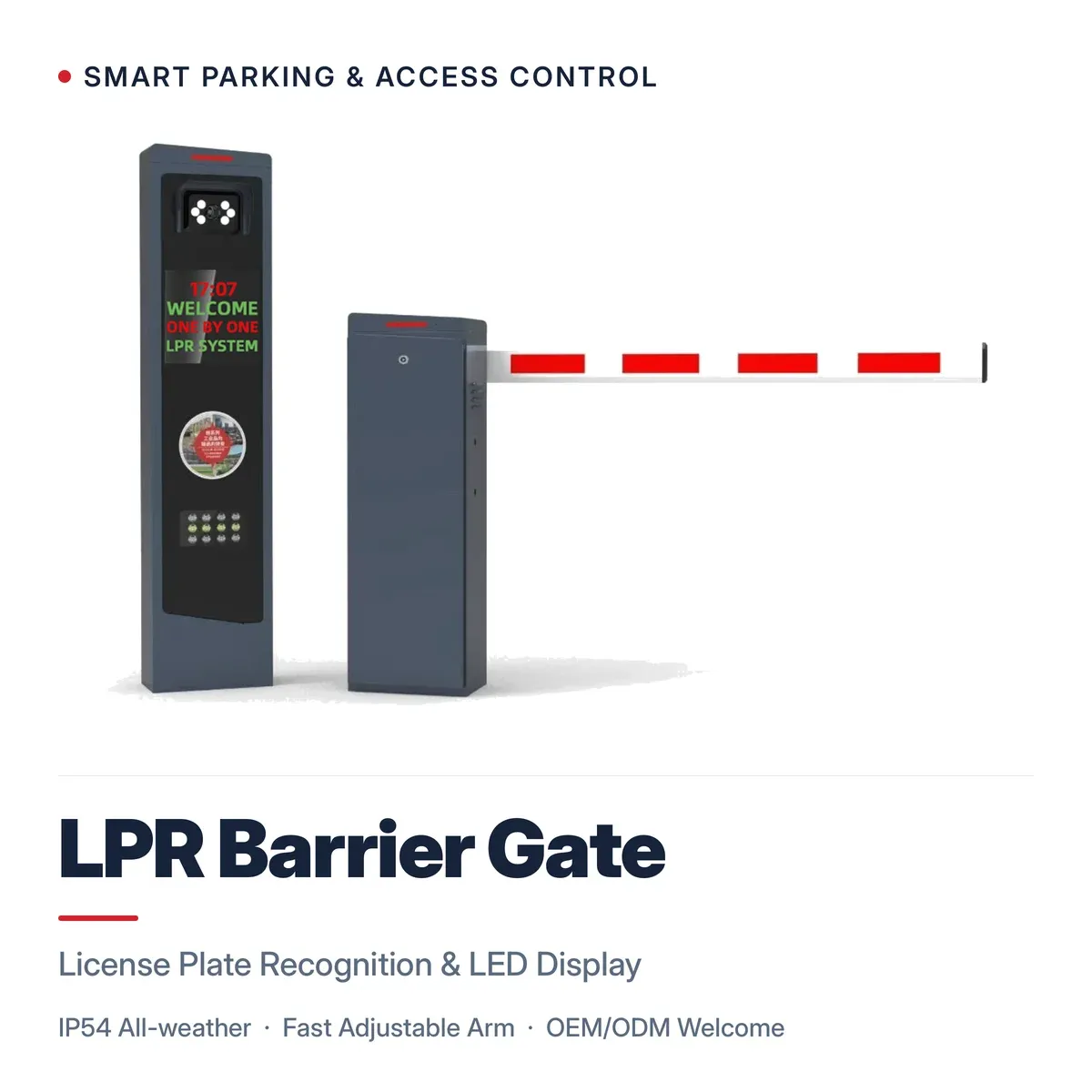
It controls a vehicle lane and, once connected to an access-control process, helps prevent unauthorised entry. It also supports traffic management and event logging as part of the wider system. It is a traffic-control device, not a substitute for perimeter security.
Yes, if the camera and software are compatible with the barrier controller. Confirm the required relay or data interface, the access logic, the failure handling and the commissioning tests for the exact models. Compatibility should be confirmed in writing rather than assumed from the product category.
RFID is convenient for repeat users who can be issued a credential. ANPR identifies registered vehicles without the driver presenting anything, but depends on camera placement, lighting and plate condition. Many sites use both: RFID for staff and regular contractors, ANPR for fleet and visitor vehicles.
Lane width, turning geometry, stopping distance, queue capacity, boom length, operating frequency, weather exposure and vehicle-detection safety. The layout must also keep the public road, pedestrian routes and emergency access clear when a lorry is waiting.
Not necessarily. A standard boom barrier is designed to control traffic. Where resistance to deliberate vehicle impact is required, specify a barrier tested and rated for that threat rather than assuming a parking boom provides it.
It depends on the controller, the barrier model and the site procedure. Agree in advance whether the lane stays secured, releases manually or follows a controlled fallback, and test that procedure at commissioning. Emergency access has to be part of the site design.
Yes. Inspection frequency should reflect the manufacturer’s guidance, traffic volume and environmental conditions. Check the mechanism, fixings, detection equipment, credentials, logs and emergency release, and record repairs and configuration changes.
Parking barriers support access control at industrial sites by providing a physical checkpoint that can work with vehicle credentials, ANPR, RFID, access software and safety detection. For UK factories, warehouses and logistics sites, the best answer is rarely the fastest barrier available. It is a properly specified and properly integrated system that matches the traffic the site receives, the risks it carries and the procedures its team can actually follow.
Before ordering, confirm the model-specific specifications, interface compatibility, safety devices, environmental rating, documentation, warranty and commissioning plan in writing. A site survey and a documented acceptance test are what make the difference between a barrier that works on the first day and one that works on every day after it. When you are ready to specify, request an industrial access control specification and include the lane and traffic detail above.
Key takeaways

 WhatsApp: +8613405313100
 Scan to add our export desk